#WhatsNext Podcast
Is The New Zealand Economy Finally Recovering?
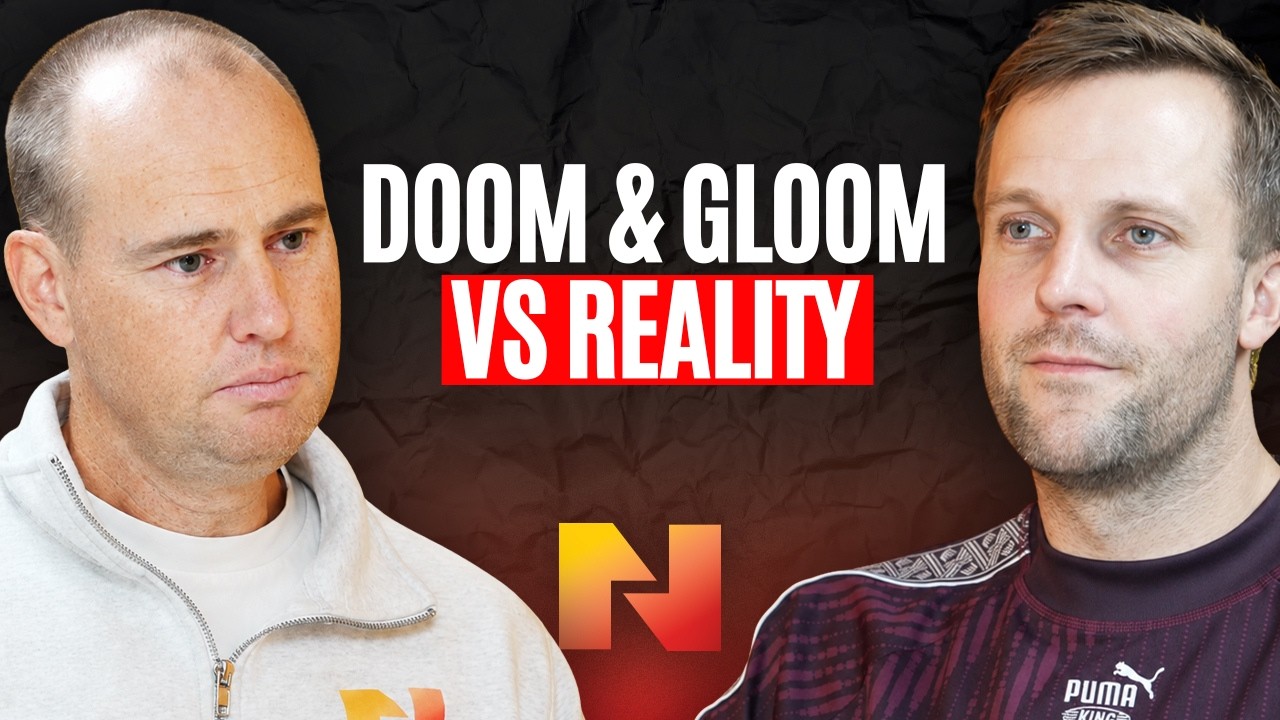

Green shoots are showing up in the data. But is anyone actually paying attention, or are we too busy doom scrolling to notice?
I wonder whether we're now seeing signs that the world's longest hangover has finally come to an end.
That's the question Phil and I have been circling for weeks now. Not because we're desperate to be optimistic... We're accountants, we deal in numbers, not vibes, but because the data is starting to tell a different story than the one everyone's used to hearing.
Let me walk you through what we're actually seeing.
The Christchurch Test Match Story
I was fortunate enough to be down in Christchurch for the All Blacks v France test. And my word, that city knows how to put on a show.
They know how to wear R.M. Williams boots. They know how to sink beers. That city is flying.
But here's the bit that matters: prior to that test, Christchurch had $26 million injected into their economy in 60 days from the stadium. This test alone brought in a few million more.
So I asked the Uber driver, because I'm a but cheeky: "This is all great, but the rugby's finished now. What are you going to do?"
His answer? "Robbie Williams is coming."
I don't think Robbie Williams is going to solve the economic woes of a city waiting for its next big thing. But here's what struck me: the diversity of tourism down there. In my hospitality seating of around 10 people, only two were from Christchurch. Everyone else traveled from outside and was spending money, and not on booze, because that was included.
That's not just rugby fans. That's people who see value in an experience and are willing to travel and spend for it.
The Hospo and Retail Warning
Now, before you think I've gone full glass-half-full on you, let's talk about where I'd still put a caveat on this recovery story: hospitality and retail.
These two industries are still in for a slog. Too many people are competing for the same dollar.
I saw a cafe that I know had a new office building go up across the road. They thought, "Awesome, more customers." Guess what opened in that new office building? Another cafe.
Now there's competition for that same dollar. And here's the uncomfortable truth: you can only really sell something to people if it's valuable to them. A lot of what's being sold in hospo and retail right now isn't as valuable as people think it is. And customers are starting to figure that out.
The Pie That Costs $13 (And Sells Out Anyway)
But here's where it gets interesting. Because value isn't dead. It's just harder to fake.
Dazzas Cooked sells pies. Good pies. Some people think they're expensive at $13 compared to a BP pie. I saw someone comment on one of his reels: "This is why your pies are too expensive. This is why you don't sell any."
Except he sells a truckload of pies. That commenter has decided they're not the customer and then extrapolated that to represent the entire country. That's not how markets work.
People buy those pies because they're good, and because Dazza has built a brand that gets people to try them in the first place. That takes storytelling. That takes content. That takes showing up.
Then there's the Fat Bastard pie down in Invercargill. When I finally tried one, my reaction wasn't "this is expensive." It was "this is far too cheap." You could add another two, three, four bucks to that pie in Auckland and people would still queue for it.
And then there's the cookie place in Christchurch. A hole-in-the-wall spot behind Ballantyne's that's apparently massive on TikTok, not that I'd know, I'm not on TikTok. My family walked past a queue of people while I just wanted a coffee. My mum came back with a biscuit, spilling crumbs everywhere, going on about how good it was.
Six or seven bucks for a biscuit. My first instinct? "That's way too cheap." If you did a cookie and coffee combo, you could charge $15 and the queue would still be there.
What This Actually Tells Us
Here's the pattern across all three of these examples: when people get the storytelling right and create a genuine experience, the price becomes almost irrelevant. People aren't just buying a pie or a biscuit. They're buying into something they can't get anywhere else.
Meanwhile, the businesses doing "effective markup" calculations, chasing a target margin percentage, and overthinking their pricing? They're missing the point entirely. The question was never "what's the right number based on our cost structure." It's "what is the market prepared to pay for what we're offering."
That's a lesson for every single business owner reading this, regardless of what industry you're in.
The Client Data That Actually Surprised Us
Here's something we didn't expect. We recently went through a round of provisional tax with clients, the kind of conversation where we tell people they need to pay more tax because their profit has increased.
Normally, this is where we hear the horror stories. "I can't afford this." "My profit's up but I haven't collected the cash." "This is going to break me."
Not this time. Almost everyone we spoke to said some version of "Yep, okay, I can handle that." A few asked if they could pay a bit later to stay current, which we can usually accommodate. But the panic, the desperation, the cash flow crises? Largely absent.
Given the doom and gloom that gets peddled out there daily, that's a fascinating signal. Most of our clients are in a good enough position to pay their tax on time. That's not nothing.
The Story You Tell Yourself
Here's the bit I want you to really sit with: has the economy actually turned, or is this about the story you're telling yourself?
If you're constantly doom scrolling, interest rates going up, unemployment at its highest, people fleeing to Australia, all these challenges the media is peddling to get clicks. The reality for you as a business owner can be a complete 180 from what you're consuming.
I'll admit I'm guilty of this too. When someone asks how business is going, sometimes I'll say "yeah, it can be tough out there" almost as a form of solidarity - like putting a counselling hand on someone's shoulder so they don't feel alone in the struggle. But when people actually ask directly? We're absolutely flying. I'm not afraid to say that.
As a business owner, it's critical that you're in control of your own economy. And you control your own economy by controlling how you think. That determines how you behave and show up every single day.
There's a line Phil and I keep repeating to clients: how you show up in your personal and private life will be a copy and paste of what your business looks like. If your life is sloppy, if you've got poor habits, if you can't make decisions - how exactly do you expect to cope in business?
The Habit That Changes Everything
Speaking of habits, here's one worth stealing. We were talking to a business owner who checks their profit and loss obsessively probably too much, by his own admission.
We told him to change the habit slightly. Every time you check the P&L, match it with an action. Follow up a lead. Make an offer. Chase an unpaid invoice. Do something to grow revenue.
Because your profit and loss is a lagging indicator of the actions you've already taken. Checking it in isolation doesn't solve anything. But checking it and immediately asking "what do I need to do differently" - that's where the magic happens.
Come back to that same P&L in six months and it'll look completely different. Not because you stared at it more. Because you did something every time you looked at it.
The Statistics New Zealand Surprise
Let's bring in some actual data, because we did call this one before it happened. We noticed a massive uptick in business planning inquiries in the first quarter of the year, people wanting to buy businesses, do strategic planning, get moving.
We thought, "if this keeps going, we're going to see GDP growth." And we did. 0.8% growth in that quarter.
Then, of course, the world decided to have a mini crisis, and everyone went into "I'm a Kiwi, better freak out" mode.
Manufacturing was actually doing well in that data too, people were making stuff, and people were buying it. The economy was growing again, even if the geopolitical noise drowned out the signal.
The OCR and the Oil Price Lesson
Here's something that should make you feel better about all the noise: when Trump announced the ceasefire had ended, oil prices moved. Guess which direction and by how much?
Up 5%. Not the 20% collapse you'd expect from the panic in the group chats. Oil sat around $70-80 a barrel before settling under $100 even after the "world ending" headline.
This tells you something important: our collective response to these events is diminishing each time. The first time the war kicked off, everyone lost their minds. Now? A shrug and a "here we go again." That's not complacency - that's regression to the mean, and it's a healthy sign that markets (and people) are getting better at not overreacting to every headline.
Centrix Confirms It
Our other good friends at Centrix released data showing how many people are behind on credit payments. It's sitting at a four-year low 423,000 people, down from the 478-490K range we normally see.
Now, some will spin this negatively: "that just means people don't have money left to spend into the economy." Fair point, sort of. But you can't have it both ways. Either people getting current on their debts is good, or it's bad. It can't be both depending on which narrative you're pushing that week.
We also saw data on financial resilience - could people come up with $5,000 in a week without accessing debt? Six in ten Kiwis said yes. We actually expected that number to be worse. And here's the kicker: that statistic hasn't moved in three years. It was the same under the last government as this one. So the "it's this government's fault" crowd needs to find a new talking point.
The Bottom Line
So, is the New Zealand economy finally recovering?
The honest answer: some very real green shoots are showing up in the data, in client conversations, and in the way money is moving through certain parts of the country. Hospo and retail are still going to be a grind because of oversupply and undifferentiated value. But businesses that tell a genuine story and create real experiences are thriving regardless of what the broader economy is doing.
The bigger lesson isn't really about GDP numbers or OCR decisions. It's about controlling what's in front of you. Keep moving forward. Keep taking action. The economy is slowly improving - but it improves fastest for those willing to make sure their own business improves first.
This article is based on insights from the Next Advisory podcast, where Luke and Phil help New Zealand business owners navigate economic challenges and build better businesses. Visit nextadvisory.nz to find out how we can help you.
Checkout more of our blog content at https://nextadvisory.nz/podcast